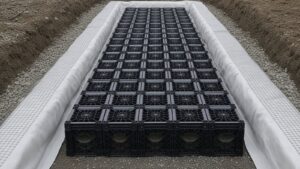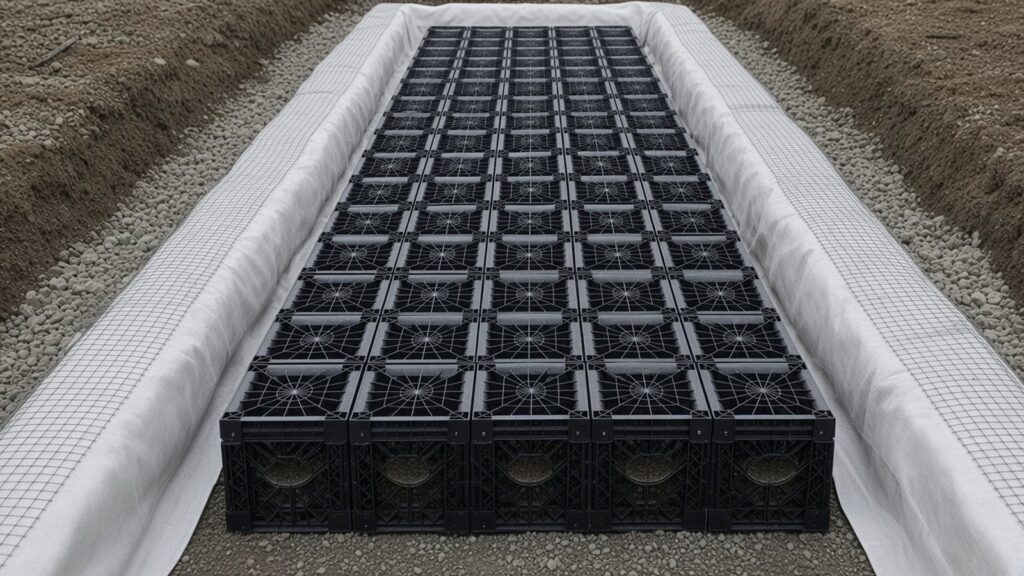
Two below-ground components appear again and again in UK drainage submissions: the soakaway and the attenuation tank. They can look similar when they are built from plastic crates, but they do different jobs, and the wrong choice is a common reason a drainage strategy is questioned.
What a soakaway does
A soakaway stores runoff and lets it infiltrate into the surrounding ground. Crates, or a stone-filled pit, are wrapped in geotextile and sized from site infiltration testing, typically following the method in BRE Digest 365. They need enough unsaturated ground beneath them, a safe setback from foundations and no pathway that would carry pollution into sensitive groundwater. If the ground cannot accept the water, a soakaway is not a fallback; it is the wrong component.
What an attenuation tank does
An attenuation tank stores runoff and releases it slowly through a flow control to an agreed outfall, such as a watercourse or sewer. Geocellular crates, large pipes or purpose-made tanks are often used under car parks and yards where there is little room for an open basin. The storage volume is the difference between the runoff the developed site would produce and the rate you are allowed to discharge, including the climate-change allowance required for the development.
Attenuation does not, by itself, make a scheme a full sustainable drainage design. National practice still looks for source control and treatment upstream, and for amenity and biodiversity where they can be provided. Permeable paving, green roofs and planted features should be considered before all the storage is placed in a single tank.
Choosing between them
Start with the discharge hierarchy and with measured ground conditions. Where infiltration is proven, a soakaway or an infiltrating pavement may deal with some or all of the runoff. Where it is not, an attenuation tank or an open basin with a controlled outfall is the usual path. Many sites use both: infiltration where it works, and tanks or basins for the remainder.
We can help you test that choice as part of SUDS design and installation and set it out clearly for planning.